
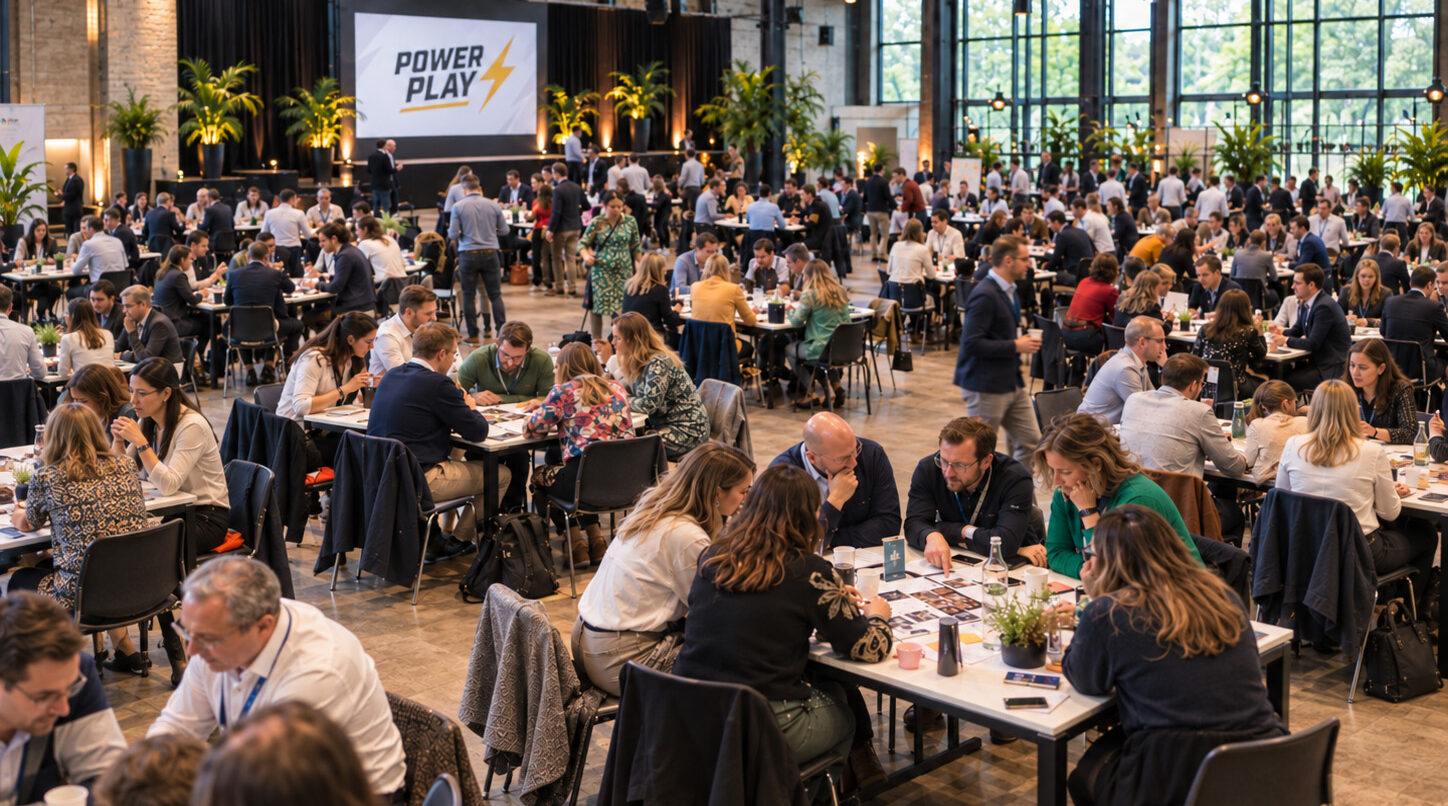
Fifty participants is not a large group. A hundred and fifty is. And somewhere between those two numbers a team building stops being an exercise and becomes a production.
This is not a matter of more equipment and a bigger room. What scales is not the activity but the organisation around it: the number of facilitators, the length of the briefing, the number of people who are doing nothing at any given moment. This guide sets out what breaks at which size, which formats in the Guide’s selection genuinely scale, and which expectation is better let go of before you book.
What breaks, and when
The numbers below are the Guide’s rules of thumb, not measured thresholds. They move with the room, the format and the number of facilitators. Use them to know what to watch for, not as a point where something suddenly flips.
Around fifty: the briefing
Up to roughly fifty participants, one facilitator can still address a group directly, explain and correct. Beyond that, explaining becomes a technical problem. You need amplification, people at the back hear half of it, and every minute of explanation costs fifty minutes of collective time.
The result is a design rule you can see in every good large-group format: the brief has to fit in one sentence and the rest has to be learned by doing. Formats that need three paragraphs of setup do not survive this scale.
Around a hundred and fifty: the overview
As a practical rule, from about a hundred and fifty participants nobody can see the whole group working any more. There are sub-teams, and they run in parallel without knowing how the others are getting on.
That can go two ways. Either the parallel structure is incidental, in which case you get ten separate activities with nothing to do with each other. Or it is deliberate, in which case the interdependence between sub-teams becomes the subject of the day. Chain Reaction is the clearest example in the selection: each small group builds one link, and only at the end does a single press of a button show whether the joins hold. The format runs to two thousand participants, and every additional sub-team makes it more itself rather than less.
Around four hundred: the debrief
Above a few hundred participants the classic debrief rarely holds up, in the Guide’s experience. A circle, a flipchart and an honest conversation about what went wrong does not work with four hundred people in a room.
This is where the Guide would rather be plain: at that scale you are no longer buying insight, you are buying a shared experience. That is a legitimate choice. A company day that ends with a moment where everybody did the same thing at the same time does something real to an organisation. But it is not the same as a team watching its own collaboration pattern take shape, and pretending otherwise helps nobody.
If you do want analysis at that scale, it has to be organised per department, at a different moment, in a smaller format.
Which formats scale
In the Guide’s selection there are broadly three ways an activity can grow.
In synchrony: everyone doing the same thing at once
Rhythmic and physical formats have no ceiling that comes from the brief, only one that comes from the room. Body Percussion runs to a thousand participants in fifteen to forty-five minutes. Boomwhackers to eight hundred in half an hour to an hour. The Haka Workshop reaches two thousand.
What you are buying here is a moment, not a process. The strength lies in eight hundred people simultaneously doing something that only works when it coincides. The limit is that there is little to unpack afterwards, and there does not need to be.
In parallel, with a join: sub-teams that have to fit together
This is the family where scale adds something. Chain Reaction to two thousand, Het Bondgenootschap to a thousand, Archipelago to three hundred, Building Bridges and Team Town to two hundred.
The more sub-teams, the sharper the point: you can finish your own part perfectly and still find it does not connect to the one next to it. At twenty participants that is an exercise. At two hundred it is an organisational diagnosis.
On one screen: many people, little space
For large groups in a single room with limited movement, some formats actively need the crowd. At the Races only starts at fifty participants and runs to five hundred, in half an hour to an hour. Powerplay and the Live Music Quiz start at forty and go to five hundred. Casino Night follows the same logic as an evening format.
For this family the floor matters as much as the ceiling: below forty participants they lose their noise, and what remains is a quiz.
And outdoors
Anyone with the space scales more easily. Beach Games runs to five hundred participants, Highland Games to three hundred and fifty, Detour to a thousand with a floor of forty. The trade-off is familiar: more space, more weather risk, more travel time taken out of the programme.
What does not scale, and why that is not a shortcoming
Several strong formats in the Guide have a low ceiling, and that is a design choice.
Drones stops at forty participants. Taiko Drums, Escape to Victory and Sheepdog Herding at sixty. The Collaboration Game and Monopolis at a hundred.
Those limits exist because the format does something that requires individual attention: a facilitator watching how a group decides, or equipment that has to be available per participant. Stretching such a format to three hundred participants does not get you the format. It gets you its name.
Three practical things to settle in advance
The facilitator-to-participant ratio. Ask for the ratio, not the number of facilitators. With large groups it is the single most reliable indicator of how the day will run.
The start. Four hundred people do not arrive at once. A format that only begins when everyone is present begins half an hour after the stated time. Formats that absorb staggered arrivals are more comfortable at this scale.
One language decision, made early. In a mixed Belgian audience of two hundred, simultaneous interpreting is rarely practical. Either you split into language streams or you choose a format that needs few words. That is why rhythmic and construction-based formats often work well for large mixed groups.
In short
As a practical rule, below fifty participants almost anything is possible. Between fifty and a hundred and fifty the briefing becomes the limiting factor. Above a hundred and fifty the sub-team structure decides whether you have one activity or ten separate ones. Above a few hundred you trade analysis for a shared moment, and that is a trade to make deliberately.
Minimum and maximum participant numbers are listed in the practical details of every activity in the selection. If the number is not settled yet, send a range through Contact; it saves a round trip.
—
If the choice is still open, start with the six questions that decide. And to work out which family fits your objective, read the comparison of the three families.